Tuesday, April 5, 2011

#1 Arrival Track Complete!


Last weekend we got another couple days of warm weather, so I was able to complete #1 Arrival track, including the connections with the 90 degree crossing into the porch and all of the related switches!


You can see a real-life photo of #1 Arrival in this 1936 postcard I recently found on ebay - the track right behind the row of baggage carts. The tracks in the foreground are the Southern Railway mainline and the depot house track. Note the Cornelia apple monument at the edge of the postcard on the right.


Back on my version of the TFRR, you can see I also added a switch to the Departure track - the tangent that runs along the fence at the far left. This will allow addition of a caboose track, which is a little parking area for cabooses that allows them to be easily added to outgoing trains or detached from incoming trains.


At that point I ran out of track, so completion of #2 Arrival track and the caboose track will have to wait a bit longer...

Sunday, March 20, 2011

Laying Track!


A couple of days above 80 degrees meant there was considerable progress by the track crew!

The first loop is complete! We could officially run a train! Too bad neither of the locos have battery power just yet.


The return loop is complete as well. The track runs down to the switch to the coal trestle track.


#1 arrival track has reached the spot where it will junction with the Southern Ry interchange track.

Tuesday, March 8, 2011

Meet the New Bender!


Unlike the smaller model railroad scales in which the track is light enough that it may be curved and bent by hand, garden railroad track is heavy enough that it must be bent by a machine - a rail bender. These specialized tools use a three roller pinching arrangement to force the track to take a curve. In this photo a short, single piece of rail has been bent all the way into a small circle:


A rail bender like this one requires the rails to be disassembled from the plastic ties before bending, then reassembled afterward. Because the inner and outer rails on a curve are of smaller and larger radii, the rails must be bent accordingly, with care taken to ensure that the rails remain in gauge (the same distance apart) from with each other. Because the tracks around Cornelia are a solid mess of curves and switches, I've been a little apprehensive about the upcoming track laying!

My mind was put totally at ease this afternoon after I tried the new dual rail bender I just got from Norm's Model Supply.


Unlike single rail benders, Norm's bender has two sets of rollers that bend both rails at the same time while they are still attached to the ties. You literally run the thing back and forth on the track in a motion like ironing a shirt and the curve appears immediately. Turn the big knob a little farther and the curve gets a little deeper.


Before:


After:


In a matter of minutes I was able to shape the lower half of the loop around the oak tree.


This bender also allows curves of specific radii to be made by using the gauge and a provided chart, but because I am bound to follow the roadboards that are already in place, I can merely loosen or tighten the main knob as needed to get the curve desired. Still, its nice to have the dial indicator and bubble levels to provide a "dashboard" to let you know what you are doing.

A little more expensive than the simple single rail benders, but the ease of use and ability to deliver perfectly curved track should make it well worth the extra investment. A huge "thumbs up" for this great tool!

Thursday, February 24, 2011

TFRR Stock Certificates


Here are examples of Common and Preferred stock certificates for the TFRR, both of which I captured in ebay auctions. The certificates are actually the same size, but the ledger has been glued back onto the left edge of the common stock making it look smaller. The last scan shows the back of the Common certificate.


Tuesday, February 22, 2011

X-5 is Looking Tired


Speaking of surviving cabooses, X-5 is looking awfully tired! This caboose is parked on the sole remaining TFRR arrival track near the Cornelia depot.


Here's a peek inside the door at the south end.


And another looking in the north end, where we can see the coal stove is intact!


From here it is so easy to imagine we have just rolled into town, that the track still stretches around the bend and all the way to Franklin.

Breakthrough at The Hole!


Last May I posted on the railroad's emergence from the porch for the first time, noting that I intended to disguise the hole and exposed frame as if it were a street crossing - specifically Chattahoochee Street.


This was always a problematic idea, as it was going to be hard to get a traffic scene right visually when the lip along that wall is so narrow. The other problem with the street crossing idea is that the locos would still have to pass under the wooden framework and out through the hole. This would be visually jarring and serve to snap the viewer out of the little diorama I am trying to compose. An overpass or similar structure would be a much better disguise for the hole, if such a thing had existed anywhere near this spot on the TFRR, as it would allow the viewer's brain to feel happy and perhaps even a little pleased to see a miniature version of that common visual experience - something passing out of sight as it passes under a foreground structure. With the street scene the train would pass in front of a truck and disappear into the Twilight Zone.

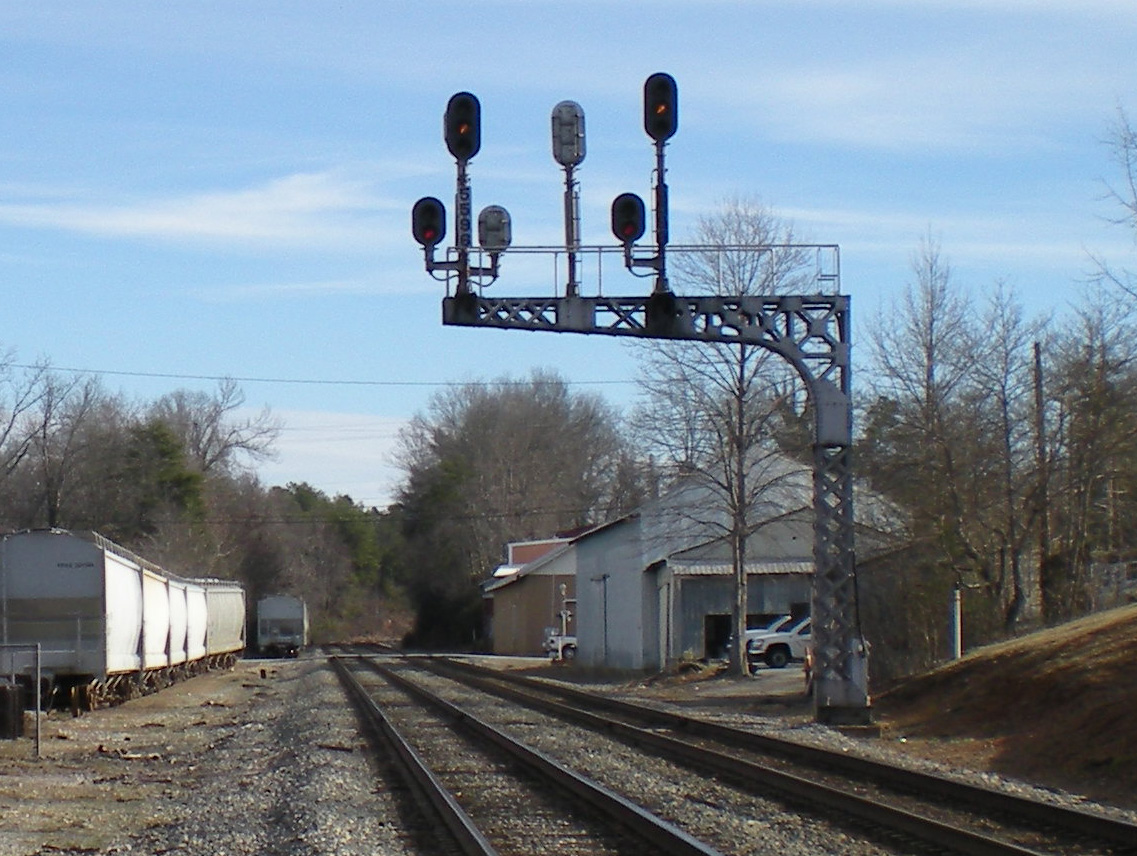
So I was flipping through some photos I had taken around the TFRR terminus, Cornelia, and came upon this exquisite detail near the depot. Its a northbound view of the block signal tower on parent company Southern Railway's Crescent Route - their mainline between Washington DC and New Orleans.


A model of this signal bridge is the perfect solution for the hole! One only has to make the tiniest speculative leap to imagine that the Southern may have decided to have built at least one signal tower for its loyal subsidiary somewhere along the way. Turning the wooden frame into a believable tower will only require painting it a dark color, covering it with a lattice of styrene plastic and topping it with one signal post for the one northbound track.

As a bonus, the simple free standing structure will open up the blank spot to the left of the hole to be decorated with a flat-front model of the machine shop that is noted on the 1922 Sanborn map of this spot in the yard, a much more believable alternative to the too-thin street scene.


As an additional bonus, using this model here will have terrific visual symmetry with the model of the Cornelia depot that will be located on the other end of that hole, helping to tie the inside and outside views together for that tiny minority of viewers that will recognize both elements. Welcome to that exclusive club, good readers!

Monday, February 21, 2011

Not X-3 After All?


I had assumed the caboose parked in Tallulah Falls was X-3, as this caboose was the only one to have the unique offset cupola, as seen in a photo in Brian Boyd's Tallulah Falls Railroad: A Photographic Remembrance (pg 23) and as a sketch in Foxfire's Memories of a Mountain Shortline: The Story of the Tallulah Falls Railroad (pg 40).

But comparing the photo and sketch with some pics I took on the way to work today revealed that there is no way that is X-3! On X-3 the cupola was moved even farther to one end, and windows were in a different pattern.


So what caboose is that in Tallulah Falls?