Saturday, August 28, 2010

Will the Circle be Unbroken!


Today I finished the ring of roadbed around the big oak tree. There was nothing like this particular feature anywhere on the TFRR, however for us it will provide the ability to have a train running on "autopilot" in the deck/porch area, as well as provide service as a reversing loop once the line is complete.

The ring is an octagon made with 2x6s for the diagonals and 2x8s for the straight sections.


In this photo you can see the ring of 1/2" plastic conduit that I used to get the circle right, a tip gleaned from the pages of Garden Railways magazine. The plank leading off to the lower left shows the approximate location of the return leg of the reversing loop. Finalizing and attaching this return leg is next on the list of things to do.


The new work has already been approved by the cat department.

Wednesday, August 25, 2010

Onward toward Manifest Destiny!


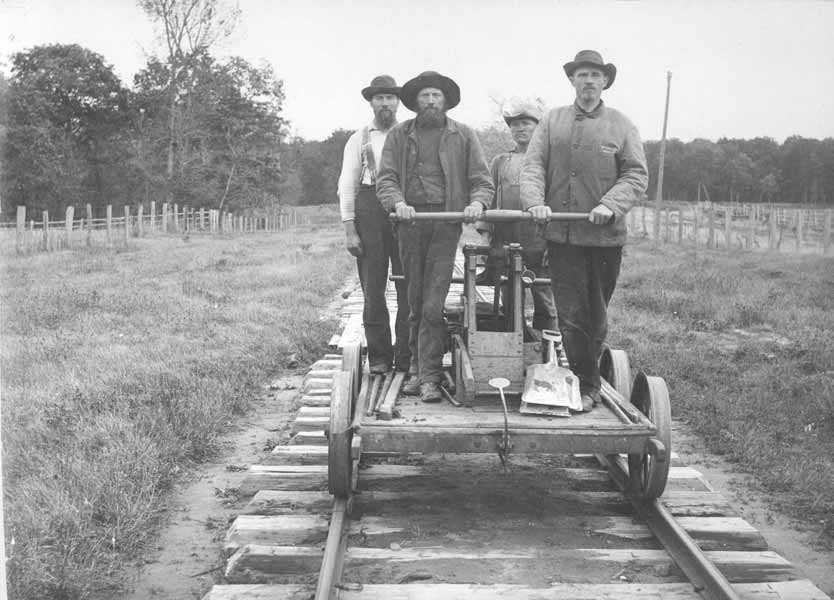
I love this photo of folks out on a railbound expedition! It looks like they are rolling off over the mountain on a sled, but closer scrutiny reveals this to be a speeder - a motorized version of the classic lever-operated hand car with which everyone is familiar.


You can try one for yourself at the Nevada State Railroad Museum in Carson City!


,

Tuesday, August 17, 2010

Last Fleet of GE 70 Tonners Retired


The June issue of Trains magazine reported that the last "substantial" fleet of General Electric 70-Ton locomotives has been retired from California's Modesto & Empire Traction Company, where the oldest of them - #600 - has seen 63 years of continuous service. The tenacious little 660 horsepower diesel switchers were no match for modern high-efficiency railroading, where the M&ET was having to use as many as seven of the tough little locomotives at a time to move 100-car unit trains of grain to transcontinental giants Union Pacific and Burlington Northern Santa Fe.

They were replaced by R.J. Corman Railpower RP20BD genset locomotives, which can pull the same size trains with just three locos. Genset locomotives ingeniously replace the single huge engine typically found in a diesel-electric locomotive with two to four much smaller engines that are brought on and off line by a controlling computer as horsepower is needed. The result is a tremendous increase in efficiency and environmental performance.

The M&ET is offering all but one of their venerable 70 tonners for sale to good homes if any of you has $95,000 burning a hole in your pocket. Understandably, they are keeping #600 for nostalgic reasons.

And while this was the last fleet of GE 70 tonners, there are still many singletons and pairs switching industrial sites and shortline railyards around the western hemisphere. The TFRR's own 70 tonners - #501 and #502 - were purchased in 1948 and run until the demise of the line in 1961, but I have never heard any details of their movement and/or disposition from there. Wouldn't it be something if either of them was still in service today!

Friday, August 6, 2010

Roadbed Progress!


Just a couple of quick photos here that show the first run of "roadbed" along the fence. Now that this is complete we can build the loop around the big oak tree and the bridge that will come over the pathway to join the roadbed that currently extends from the portal into the screen porch.


Wednesday, July 21, 2010

The End at Last for Texaco in Clarksville?


One of the remaining structures from the days of the railroad is a defunct Texaco dealership located just south of Clarkesville, currently found on the side of Georgia Highway 385, also called "Historic US-441". At the risk of sounding like Grandpa Simpson, when I was a kid this was THE road to Rabun County... now its "historic".

Here it is in a photo of a photo taken in Dess Oliver's TF museum in Rabun Gap, followed by a current photo of the same place where the old tanks have snoozed in the bushes for many years.


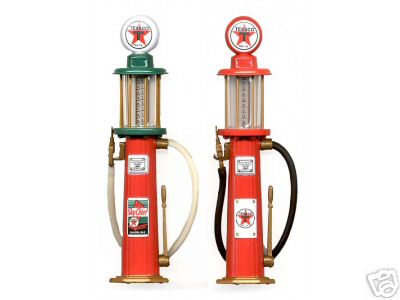
I have definitely been planning to model this facility with Clarkesville thanks to its simplicity and charm - a couple of pineapple juice cans will make great tanks, and I've already found an inexpensive Texaco tank car by Bachmann and a set of cool 1:25 scale Texaco gas pumps for the retail side of the operation .


So I was saddened the other day to come by and find one of the big horizontal tanks gone and the remaining tank strapped to a low-boy trailer - destined I suppose for sale or the scrapyard. This may be a one-off sale of these tanks, or possibly the first step is dismantling this little relic of the TFRR to make space for a burger joint, or perhaps a shop where the citizens of Clarkesville can buy lottery tickets and beer. You know, something important.


Here's the "before and after":


Sunday, July 11, 2010

Fence Line Timbers Complete!


Over the last couple of weeks I have been working on building and installing the arms that will support the rail bed on the big posts along the east fence. From the standpoint of the railroad, this is the southernmost section of the line - from Cornelia to the outskirts of Demorest, or about five miles. In the real world this will support the first 55 feet or so of track and structures.


This last photo shows the crossbeam that will support the rail beds in place. The carriage bolts allow exact adjustment of the the beam to correct height and to keep everything level. I expect this to be helpful as all of this wood ages out, with the inevitable twists and torques and warps.

The goal is to have all this in place and the track laid before the end of August so that we can be certain the track is at its maximum length when considering thermal expansion.

Sunday, May 30, 2010

More on the TFRR's Passenger Train

To me there is nothing that speaks more directly of the golden era of railroading than steam engines pulling "old varnish" passenger trains - wooden coaches and baggage/mail cars with open front and rear platforms, clerestory windows and a potbelly stove in one corner. On my imagining of the TFRR the passenger business is stronger than ever - a mix of public transportation, tourist excursions, and seasonal/event specials in an alternate universe where the crude experience delivered by the gasoline engine remains a distant second to the comfort and convenience of rail travel in the mind of the public.


So far the TFRR passenger fleet consists of these two cars: a baggage/mail car and an observation car, which is a passenger coach or lounge car with a bit of a fenced in platform out the back door. This platform would be the place for passengers to see the scenery roll by while moving and politicians to make speeches while stopped.


As noted in the previous post, both of these were gotten for a song on ebay, leftovers from the vast fleet of forsaken "Big Hauler" Christmas-tree-friendly train sets made by Bachmann Trains. I really like the look and weight of these cars. They don't the museum quality detail of cars by Accucraft or AMS, but do not succumb to what to my tastes (and for the TFRR) is the overly-cute look of the shortie passenger car fleets offered by LGB and Hartland Locomotive Works.

The black and white photos I've seen of prototype TFRR passenger cars give no hint of their actual color, so both of these were painted with this yellow and brown paint scheme that I imagined the railroad might have had or adopted.

At some point I'd like to add two more coaches to this train, then "name" each of the three passenger cars for a waterfall found in each of the counties where the TFRR ran: Panther Creek Falls (Habersham), Minnehaha Falls (Rabun) and Big Laurel Falls (Macon). Needless to say, they all also need basic lettering.

My observation car started in a maroon "New York Central Lines" paint scheme with a broken rear step and deck.


Here's the "after" shot of the same car, where you can see that rather than repair the broken step I removed both rear steps altogether to increase the space on the enclosed observation deck. Since I'd removed the steps there was no need for the grab irons, so I removed those and filled the mounting holes with wood putty.


I also simplified the enclosing rail, trimming out all the diagonals and painting them green. On the very back I carefully trimmed out the right mix of struts to leave it spelling out a blocky "T" and "F" - a small short line railroad's answer to the fancy illuminated tail signs of the big, wealthy railroads. But I'm not completely satisfied with the yellow paint used for the "TF", as it tends to disappear against the yellow background of the car's wall when viewed from the rear.


Three passengers can be glimpsed through the windows, waiting for the train to leave the station. It amazes me how a few figures can instantly bring some life to the scene.


The interior got thin washes of brown paint that matted out the shiny plastic look, plus brought out wood grain cast in the floorboards. There was a large plastic blob left in the center of the car by the injection molding process. Rather than carve this thing out, I drilled a hole in the center and painted it gold, producing what I hope resembles a spittoon at first glance.


Here's the baggage/mail car.


I plan to model one end as a Railway Post Office (RPO), which was a special kind of mail car in which a postal agent actively sorted the mail picked up as the train rolled down the track, providing same-day mail service to the towns directly served by the railroad. (To learn more about the operation of RPO's, click here for a great 1936 documentary on the mail trains on the London, Midland and Scottish Railway.)

The other end will be modeled as a mix of passenger bags, boxes and the various mix of other items that was transported by the railroad - anything from a crate of chickens to a bundle of apple tree seedlings.

This car is also missing some handrails on one end. At some point I would like to replace all of the rinky-dink plastic handrails and grab-irons on these cars with some simple brasswork - tubing and/or solid wire.

Still to do on these cars:
* All lettering!
* Interior details of baggage/mail car
* Complete Kadee coupler conversion. Right now there is a motley mix of one Bachmann coupler, two body-mounted Kadee 830's and a truck mounted Kadee 909 that looks grotesque on the end of that long arm.
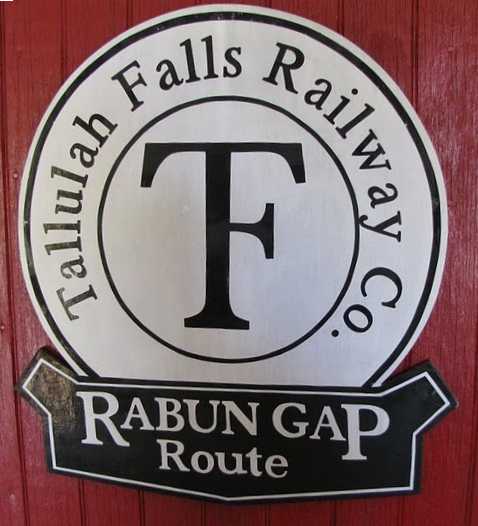
* Finally, I'm hoping to win permission to use the cool reimagined TFRR corporate logo that you can see at the museum in Rabun Gap between the doors on the baggage/mail car. Or I may modify it into my own version by adding some simple mountain peak outlines to the inner circle.