Sunday, September 18, 2011

Coal Trestle at Cornelia Part 2


The general location of my model of the Cornelia coal trestle was established early on; just north of the oak tree on the way "out of town", generally following the positioning of this feature on the prototype. The effort to design the model began with stacking and rearranging lots of pieces of scrap wood on the worktable to try to get a sense of the geometry of the thing. A key factor was the need to keep the design very open so as to allow easy blowing of the leaves, acorns and other debris that pour like a woody waterfall off the giant oak tree overhead. A secondary goal was to repurpose a rugged looking piece of wood saved from the little laundry room that preceded the nice porch that we have now, which is the horizontal piece with the rusty nail holes on the middle level in the photo below:


From there I carefully cut and attached everything together into the first version of the trestle, but upon mounting it on the line and attaching the 1/2" conduit to reveal the shape of the track I was dismayed to see how incredibly steep the approach would be!


This seemed like it was sure be a source of trouble when trying to spot hopper cars atop the trestle, so it was back to the worktable to cut the legs down to a more reasonable height. By also moving the switch farther up the line I ended up with a much more gradual slope. Here's a long shot of the whole siding.


As an added bonus, the longer grade allowed me to build in a flat spot large enough to spot a car about halfway up the slope, shown here centered on the post on the left.


I'm planning to model this spot as the Spencer ice factory, proceeding with the idea that northbound and southbound reefer cars would have been iced at this plant before proceeding up the TFRR or being spotted on the Southern Ry interchange track before moving on to the wider world. Perhaps additional research will reveal a photo of this operation! Here's a stock photo of a model icing platform in HO scale:


In the meantime, the next elements to complete were the supports along the grade. This was extremely easy to do with the plastic conduit in place, as I only had to position the boards that would become the piers next to the conduit to see how tall each one needed to be, as well as the angle of slope atop each. These are spaced roughly 12" apart, allowing plenty of room to dispatch any leaves and other debris with the power blower.
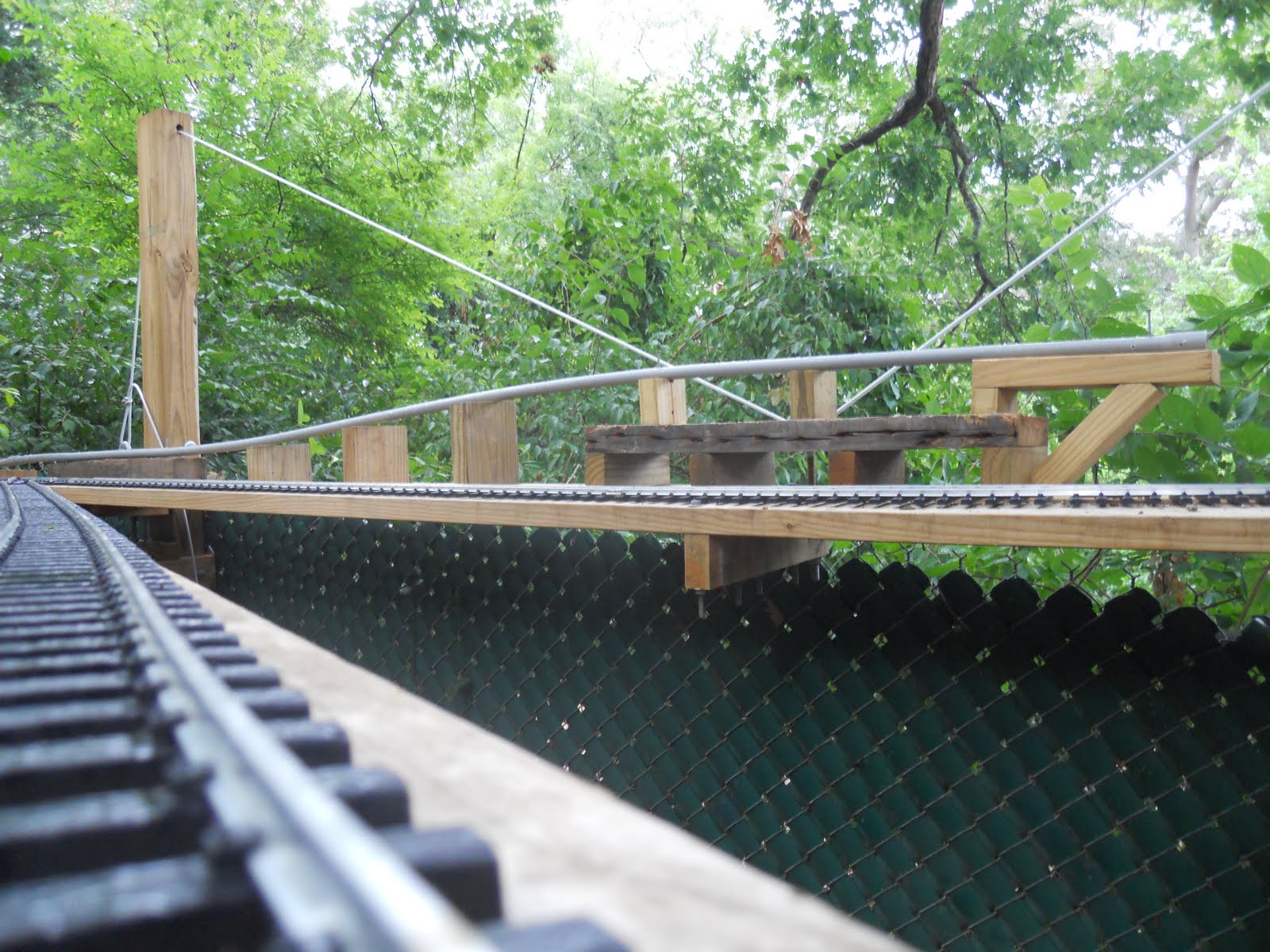


Now all that remains is to lay track, which will happen as soon as my back order of flex ties is finally fulfilled, and then to model the little hut that was positioned at the left end of the middle level, which I can only presume was a place for the wheelbarrow operators to get out of the weather when not working the coal pile.

Saturday, August 27, 2011

Three Photos from Ebay!

I just acquired negatives for three TFRR photos from "Lemonade Squeeze", an online vendor.

The first is extremely exciting, as it provides the only clear view I have ever seen of the 10,000 gallon water tank that is indicated on those 1922 Sanborn maps. A 1938 photo on page 32 of the 2nd Edition of Brian Boyd's book shows the tank peeking up behind loco #75, but a 1943 photo on page 33 shows that the tank has been removed. The tank is a match for the tanks shown in undated photos of Joy and Mountain City. Other photos in Mr. Boyd's book indicate the water was delivered by a boring old water hose in later years.


I'm not totally sure where this photo is located, but I think we are atop the deck girder bridge that crossed Tallulah Falls Lake looking east at the intersection between the two legs of Terrora Circle.


Likewise, I am not totally sure about this photo, but my guess is that we have just come through the deep cut that is now filled by the modern, four-lane version of US-441 and are looking southbound, with "Old 441" and the Tallulah River on the right. The Joy depot and water tank should be in view on the track just ahead to the north. I think the cut behind us was the one decorated to look like a tunnel for Disney's "The Great Locomotive Chase".


Friday, August 5, 2011

Coal Trestle at Cornelia

From its formation in 1898 until the purchase of the two GE-70 Ton diesels in 1948, the Tallulah Falls Railroad ran entirely on steam power. At the turn of the century that meant wood burning locomotion, but photos in Brian Boyd's book shows coal burning engines in photos dated as early as 1917.

While larger railroads used coal towers to load tenders quickly, the TFRR built an elevated coal dock onto the tall embankment on the east side of the tracks just north of the shop so that any northbound locos would pass right by it.

Here's a snapshot of a photo of the coal trestle from Dess Oliver's TFRR museum in Rabun Gap, which shows how open hopper cars filled with coal could be dumped through the trestle, then transferred to the locomotive tenders waiting on the middle level by men wielding the fleet of wheelbarrows seen on the middle level. I think I can see the headlamp of an approaching loco at the far right!


This 1922 Sanborn fire insurance map shows the location of the coal dock circled in red, found at the end of a block-long siding that is shown as originating just north of Clyde Place (now Elrod Street). Note the second siding that peels away to the southeast, serving "Robert Spencer's Planing Mill" and a "Lumber Storage" building or area, as well as a building labeled "Ice Factory" between the coal and industry sidings (circled in blue). Before the introduction of mechanical refrigeration cars in 1951, all railroad cars of this type used ice to keep perishables fresh. However, whether or not the Spencer ice factory was providing this service to cars on the TFRR is unknown to me.


Here's a southbound view taken in 2009 that looks across Clyde/Elrod Street. The very end of the surviving TFRR mainline is on the right. At the left we can see the remains of the curved Spencer siding in the little alley between the two buildings. It may be my imagination, but it seems like there is a track-shaped double bump that crosses under the asphalt and continues directly under the parked semi truck in the spot where the map indicates the coal siding was located. Since the corner of existing warehouse sits atop this siding it must have been built after coal service ended.


However, upon shifting to a northbound view and moving alongside the same warehouse, we see the remains of a switch, the mainline on the left and the beginning of a siding that continues up the hill behind us. So perhaps the coal siding was merely shortened sometime after the November 1922 date on the Sanborn map?


Walking up the hill reveals tracks that are still in place, as well as a few concrete bases for uprights that are no longer present. All of these relics are virtually invisible under a tremendous tangle of kudzu, undergrowth and trees small and large.


Mysterious to me is this skeleton of a belt conveyor in the vicinity of the coal trestle. Was the labor-intensive trestle and wheelbarrow system abandoned in favor of this conveyor in the later years of steam power? Using a conveyor to move coal directly from a hopper car to the steam engine's tender was a pretty common way of loading coal in small rail yards, but I don't really know if that's how this conveyor was used.


From the modeling perspective, conveyors are not as exciting as such an iconic feature as the original coal dock! The ice plant also offers nice potential, both for modeling of the structure and then as an operational feature when running trains, as it would make sense to send all reefer cars for icing either before running the train north or dropping those cars on the Southern Ry interchange track.

Saturday, June 25, 2011

Sunday, May 29, 2011

Illinois Central Piggy Back


Here's another great find from the sale at Trainmaster Models - a 1940's era piggy back car marked for the Illinois Central Railroad. These cars were the predecessors to the modern goods delivery system - the modular containers that have all but replaced boxcars due to their ability to move seamlessly from ship to rail to truck.


New Log Buggies


This week our pals at Trainmaster Models have been having a spring sale, so I was able to pick up a string of used LGB log buggies for a song. I don't really know if the TFRR ever ran disconnected log cars like these, but there was definitely plenty of logging going on along the line, so these were too cool to pass up. Usually cars like these would run in pairs, but the deal I struck required that I buy all they had - seven of them. Since I ended up with an odd number, eventually I'd like to convert one of them into either a derrick or tool car.


Wednesday, May 11, 2011

New Neighbors Moving In!


Here's the view from our bathroom window, followed by a clip of the family of Carolina Wrens that are moving in.


SO cute!